
Get the flash player here: http://www.adobe.com/flashplayer
30 May 2010

28 May 2010
Earthtree
Website for Singapore-Norwegian Television company, Earthtree. http://www.earthtree.com.sg/
Get the flash player here: http://www.adobe.com/flashplayer
27 April 2010
Beyond Words
Writing has come a long way since the first scratches of abstracted images on stone. It has influenced the way we think by giving us the ability to record our thoughts visually, which has in turn, contributed to the collective memory of society over the millennia.
For most people, writing is separate from the plastic arts. The form of text has nothing to do with the content of the words that are written. It is reasonable to assume that since the words have meaning in themselves, independent of the way they are written or presented, then the method in which they are put down in ink or print, and finally viewed, is of negligible importance. Only that the words are legible and that the conditions for writing and reading them in are sufficiently conducive.
However, this isn’t always the case. Writing is a visual means for the structuring and communication of information and sellers of luxury notebooks have managed to exploit this to the extreme. In some circles, notebook keeping has become an art in the recording and presentation of visual-textual information. Linear narratives are the norm, but ideas, like puzzles of all sorts, can be expressed through disparate patches of coherent thought, with embellished texts, emoticons, detailed diagrams and what not, later then on to be linked together to form the final picture or solution.

There are many situations in which a non-linear method of the presentation of an idea or thought is preferable to a linear one. A large collection of information on a particular subject, for example, might be best expressed on a two-fold page spread that shows collections of data from different aspects that are important to its understanding. Many contemporary news journals employ this to great effect, taking advantage of the reader’s ability to link disparate information together. However, this form of information presentation is also easily exploited, as no untruth needs to be said if the author wishes the audience to infer a biased opinion.
In the 1920s, the German Dadaists combined in collages, disparate texts and pictures to make politically charged art. The value in the text consisted of both the definition of the word itself, for example, LOVE, and its typographic style, and of course the pictures that accompanied it. Textual information cannot be consumed out of context, be it on the printed page, or in the current social and political climate. The words “World Trade Center” have different connotations pre and post 9/11.
In the days before writing machines were invented, penmanship was of great importance. Good penmanship signified good upbringing, civility and class. For a few decades, graphology was even an accepted subject at institutes of higher learning. However, like astrology, there has been no scientific proof to back it up, only opinion. And mere opinion alone only ever ranges from the merely entertaining to the potentially harmful.
But since the advent of machine type, good penmanship has fallen into the fold and is now only of importance to parents with very young children who still believe good handwriting is a sign of intelligence, discipline and adequate neuromotor control.
Since the early 1800’s, Typography has steadfastly usurped penmanship over the visual meaning of words such that the form of the text implies information beyond the text itself. And ever since designers realized the power of designed text to affect our environment and our social and political consciousness, they have exploited it to great effect.
For most people, writing is separate from the plastic arts. The form of text has nothing to do with the content of the words that are written. It is reasonable to assume that since the words have meaning in themselves, independent of the way they are written or presented, then the method in which they are put down in ink or print, and finally viewed, is of negligible importance. Only that the words are legible and that the conditions for writing and reading them in are sufficiently conducive.
However, this isn’t always the case. Writing is a visual means for the structuring and communication of information and sellers of luxury notebooks have managed to exploit this to the extreme. In some circles, notebook keeping has become an art in the recording and presentation of visual-textual information. Linear narratives are the norm, but ideas, like puzzles of all sorts, can be expressed through disparate patches of coherent thought, with embellished texts, emoticons, detailed diagrams and what not, later then on to be linked together to form the final picture or solution.
There are many situations in which a non-linear method of the presentation of an idea or thought is preferable to a linear one. A large collection of information on a particular subject, for example, might be best expressed on a two-fold page spread that shows collections of data from different aspects that are important to its understanding. Many contemporary news journals employ this to great effect, taking advantage of the reader’s ability to link disparate information together. However, this form of information presentation is also easily exploited, as no untruth needs to be said if the author wishes the audience to infer a biased opinion.
In the days before writing machines were invented, penmanship was of great importance. Good penmanship signified good upbringing, civility and class. For a few decades, graphology was even an accepted subject at institutes of higher learning. However, like astrology, there has been no scientific proof to back it up, only opinion. And mere opinion alone only ever ranges from the merely entertaining to the potentially harmful.
But since the advent of machine type, good penmanship has fallen into the fold and is now only of importance to parents with very young children who still believe good handwriting is a sign of intelligence, discipline and adequate neuromotor control.
Since the early 1800’s, Typography has steadfastly usurped penmanship over the visual meaning of words such that the form of the text implies information beyond the text itself. And ever since designers realized the power of designed text to affect our environment and our social and political consciousness, they have exploited it to great effect.
Links:
22 April 2010
Dens(city)
Panels from a styling sheet for a 2 minute video on how we will live in the year 2030. The concept behind this is that in an attempt to live greener lives, we live in denser, increasingly self sufficient cities, which place less burden on our strained ecology.
Get the flash player here: http://www.adobe.com/flashplayer
09 April 2010
About Babelogica
Babelogica is a personal blog on design and media culture by Isabella Chen. The content is focused on how contemporary design affects the way we think, live and value the things that seem to matter to us. It is about how designers attempt to give structure and imbue value into our environments through their craft, but also about how design trends also arise from the ground up; be it there urban organization of developing metropolises, the adoption of trailer trash fashion trends by haute couture, etc.
Isabella Chen is a story artist, graphic designer and a writer on trends in society, with a focus on design, science and technology. She currently specializes in narrative design for both print and video.
This basically means she does research, writes articles and/or scripts, draws story-boards, and does layouts.
Isabella Chen is a story artist, graphic designer and a writer on trends in society, with a focus on design, science and technology. She currently specializes in narrative design for both print and video.
This basically means she does research, writes articles and/or scripts, draws story-boards, and does layouts.
09 March 2010
Dresden Codak
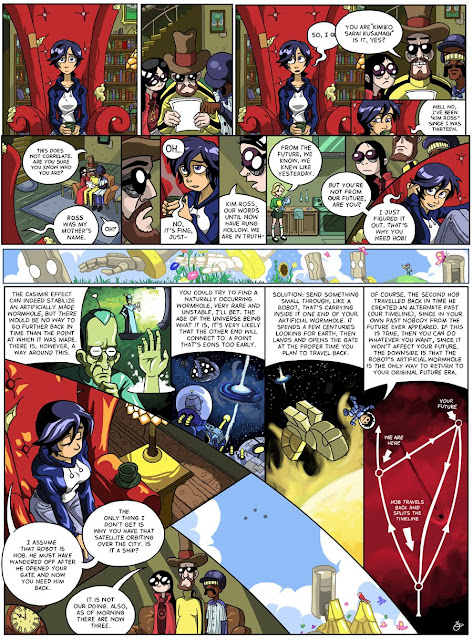
Finally been introduced to Dresden Codak. It's the ultimate geek comic. The way I see it, it's a steampunk adventure story that draws from a multitude of theories about the natural world (regardless of whether they have been proven or not) some of them rather fantastical, and weaves stories using these elements. It's like the comic I've been looking for for years. It's not all science fiction, although it does have an element of that, and it's not SF in the vein of Star Wars of Battlestar Galactica. It's much less bombastic and not as epic, and there's a lot more focus on the geek side of things. It takes all the new funky discoveries you might read in WIRED or Discover and integrates it into the world. It's awesomeness.

03 March 2010
Donatella Versace and the Uncanny Valley
The world would be a far less horrific place if there was a cap on what sort of plastic surgery a person can get. I was watching the Versace story on the Bio channel when it occurred to me how Donatella V. has joined the ranks of plasticked out women and entered the Uncanny Valley.
It's prophetic I swear. Like something out of a bad Science Fiction movie where robots and humans eventually converge into the Uncanny valley, one in the attempt for naturalism, the other, for artificiality. Eventually Earth is overwhelmed by a race of sub-humans with repulsive faces from which you can not read anything from. With all emotion and feeling abolished from facial expression, we become a race where emotions are felt from a statistical analysis of events and actions from a person's past.
Seriously, can you imagine an entire drama with actors that have undergone so much plastic surgery you can't read their expressions anymore? Oh wait... no need to imagine there.
Fear not...

It's prophetic I swear. Like something out of a bad Science Fiction movie where robots and humans eventually converge into the Uncanny valley, one in the attempt for naturalism, the other, for artificiality. Eventually Earth is overwhelmed by a race of sub-humans with repulsive faces from which you can not read anything from. With all emotion and feeling abolished from facial expression, we become a race where emotions are felt from a statistical analysis of events and actions from a person's past.
Seriously, can you imagine an entire drama with actors that have undergone so much plastic surgery you can't read their expressions anymore? Oh wait... no need to imagine there.
Fear not...

Subscribe to:
Posts (Atom)

